23ANDME- MY HAPLOGROUP Y-DNA

This is a printable version of your report and may contain sensitive and personalized information.
Please when you are done printing.

ANTONIO FLORENTINO
Paternal Haplogroup
You descend from a long line of men that can be traced back to eastern Africa over 275,000 years ago. These are the men of your paternal line, and your paternal haplogroup sheds light on their story.

ANTONIO, your paternal haplogroup is E-P252.
As our ancestors ventured out of eastern Africa, they branched off in diverse groups that crossed and recrossed the globe over tens of thousands of years. Some of their migrations can be traced through haplogroups, families of lineages that descend from a common ancestor. Your paternal haplogroup can reveal the path followed by the men of your paternal line.
Migrations of Your Paternal Line

Haplogroup A
The stories of all of our paternal lines can be traced back over 275,000 years to just one man: the common ancestor of haplogroup A. Current evidence suggests he was one of thousands of men who lived in eastern Africa at the time. However, while his male-line descendants passed down their Y chromosomes generation after generation, the lineages from the other men died out. Over time his lineage alone gave rise to all other haplogroups that exist today.
Haplogroup DE-M145
The first steps of your paternal-line ancestors lead from eastern Africa north towards the Red Sea and haplogroup DE-M145. The DE lineage branched away from its brothers around 65,000 years ago, among the first of our ancestors to cross out of Africa into the Arabian Peninsula. Most descendants of the DE lineage belong to one of its two branches, D and E. Men carrying D moved east into Asia and those with E moved west through Africa and into Europe.
Haplogroup E-M96
Your path branched off again over 60,000 years ago with the rise of haplogroup E-M96, also simply called haplogroup E. The common ancestor of E-M96 may have lived in northeastern Africa or in the Arabian Peninsula. Since then, his descendants have carried it throughout the African continent and into neighboring regions of Europe and the Middle East.
Origin and Migrations of Haplogroup E-M180
Your paternal line stems from the E-M180 branch of E, which dominates south of the Sahara. The haplogroup originated about 17,000 years ago in the pockets of western Africa that were habitable at the time, when much of the continent was extremely dry due to Ice Age climate conditions.Over ten thousand years later, men bearing haplogroup E-M180 migrated throughout sub-Saharan Africa, spurred by the development of agriculture and iron-working in the region.
E-M180 is most common today among speakers of Bantu languages and those related to them; it reaches levels of up to 90% among the the Mandinka and Yoruba of western Africa, where the migrations began. Farther from their origin, E-M180 reaches frequencies of 50% or higher in the Hutu, Sukuma, Herero, and !Xhosa. The lineage is also the most common haplogroup among African-American male individuals. About 60% of African-American men fall into this haplogroup primarily due to the Atlantic slave trade, which drew individuals from western Africa and Mozambique, where E-M180 accounts for the majority of men.
E-P252
Your paternal haplogroup, E-P252, traces back to a man who lived approximately 12,000 years ago.
That's nearly 480 generations ago! What happened between then and now? As researchers and citizen scientists discover more about your haplogroup, new details may be added to the story of your paternal line.
E-P252 is relatively common among 23andMe customers.
You share an ancient paternal lineage with Pharaoh Ramesses III.
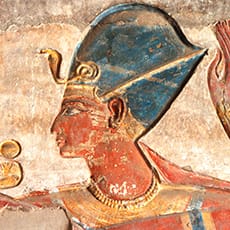
Pharaoh Ramesses III defended Egypt in three consecutive wars during his approximately 30-year reign, but provoked dissent within his administration. Catalyzed by mounting internal strife, one of Ramesses’s lesser wives, Tiye, hatched a plot to have her son, Pentawer, usurp the throne by having Ramesses III murdered along with his appointed heir. A papyrus record of the resulting trial explains that the plot failed and that all involved were tried and convicted.
However, a modern CT scan of Ramesses III’s mummy revealed a deep slit in his throat, reopening a case long thought closed. The embalmers went to great lengths to cover up other wounds, including fashioning a fake toe out of resin where Ramesses’s real one had been hacked off, likely during a fatal attack. For thousands of years, Ramesses’s burial adornments concealed the wounds that mark one of the most famous royal dramas in history. Ramesses III's paternal lineage belongs to haplogroup E-V38, from which your line also stems. You and Ramesses III share an ancient paternal-line ancestor who probably lived in north Africa or western Asia.
The Genetics of Paternal Haplogroups
The Y Chromosome
Most of the DNA in your body is packaged into 23 pairs of chromosomes. The first 22 pairs are matching, meaning that they contain roughly the same DNA inherited from both parents. The 23rd pair is different because in men, the pair does not match. The chromosomes in this pair are known as "sex" chromosomes and they have different names: X and Y. Typically, women have two X chromosomes and men have one X and one Y.
Your genetic sex is determined by which sex chromosome you inherited from your father. If you are genetically male, you received a copy of your father's Y chromosome along with a gene known as SRY (short for sex-determining region Y) that is important for male sexual development. If you are genetically female, you received a copy of the X chromosome from both of your parents.

Paternal Inheritance
Each generation, fathers pass down copies of their Y chromosomes to their sons essentially unchanged. Between generations, the matching chromosomes in the other 22 pairs make contact and exchange segments of DNA. This process shuffles the genetic information that is passed down from parent to child, making it difficult to trace genealogy over many generations. Except for two tiny sections at the chromosome's tips, however, the Y skips this step. Instead, a nearly identical copy is handed down each time.
But, every so often, small changes to the DNA sequence do occur. These changes, called mutations, create new genetic variants on the Y chromosome. Because the Y does not recombine between generations, these variants collect in patterns that uniquely mark individual paternal lineages.

Paternal Haplogroup Tree
To trace the genetic history of paternal lineages, researchers compare the variants found in Y-DNA sequences from around the world. The result is a tree of Y chromosomes that shows how all paternal lines are related.
A paternal haplogroup is a cluster of branches on the tree that stem from a common male ancestor and share a particular set of variants. To keep track of all the branches, the major sections of the tree are named with one or more capital letters. Each haplogroup name starts with the letter of the major branch from which it stems and ends with the name of a variant that identifies a particular subgroup.
Visit the scientific details to see your lineage in the tree of all paternal haplogroups.
Tracing Male Migrations
Because closely related haplogroups tend to share geographic roots, researchers can use the modern distributions of haplogroups around the world to trace major migrations, from the voyage to Australia over 40,000 years ago to the peopling of North and South America in the last 16,000 years.

Scientific Details
Your haplogroup can tell you about your paternal line.
Each generation, fathers pass copies of their Y chromosomes on to their sons. Whereas most of the genome exists in two copies that exchange pieces between generations in a process called recombination, the Y chromosome is transmitted unshuffled. Because of this unusual pattern of inheritance, the Y contains rich information about paternal lineages.
A small number of DNA changes, called mutations, generally occur from one generation to the next. Because the Y chromosome does not recombine between generations, these mutations accumulate in patterns that uniquely mark individual lineages, and scientists can compare the resulting sequence differences by constructing a tree. This tree shows how paternal lineages relate to one another, including the observations that all human paternal lineages share a most recent common ancestor approximately 275,000 years ago.
The term "haplogroup" refers to a family of lineages that share a common ancestor and, therefore, a particular set of mutations. Each paternal haplogroup is named with a letter indicating the major cluster of branches to which it belongs, followed by the name of a mutation that is shared by a subset of the major cluster.
We identify your haplogroups by determining which branches of the Y-chromosome tree correspond to your DNA. Because more closely related lineages tend to share geographic roots, your haplogroup can provide insight into the origins of some of your ancient ancestors.
References
- Al-Zahery N et al. (2003). "Y-chromosome and mtDNA polymorphisms in Iraq, a crossroad of the early human dispersal and of post-Neolithic migrations." Mol Phylogenet Evol. 28(3):458-72.
- Alonso S et al. (2005). "The place of the Basques in the European Y-chromosome diversity landscape." Eur J Hum Genet. 13(12):1293-302.
- Arredi B et al. (2004). "A predominantly neolithic origin for Y-chromosomal DNA variation in North Africa." Am J Hum Genet. 75(2):338-45.
- Balanovsky O et al. (2008). "Two sources of the Russian patrilineal heritage in their Eurasian context." Am J Hum Genet. 82(1):236-50.
- Barać L et al. (2003). "Y chromosomal heritage of Croatian population and its island isolates." Eur J Hum Genet. 11(7):535-42.
- Beleza S et al. (2005). "The genetic legacy of western Bantu migrations." Hum Genet. 117(4):366-75.
- Bereir RE et al. (2007). "Co-introgression of Y-chromosome haplogroups and the sickle cell gene across Africa's Sahel." Eur J Hum Genet. 15(11):1183-5.
- Bosch E et al. (2001). "High-resolution analysis of human Y-chromosome variation shows a sharp discontinuity and limited gene flow between northwestern Africa and the Iberian Peninsula." Am J Hum Genet. 68(4):1019-29.
- Bowden GR et al. (2008). "Excavating past population structures by surname-based sampling: the genetic legacy of the Vikings in northwest England." Mol Biol Evol. 25(2):301-9.
- Capelli C et al. (2006). "Population structure in the Mediterranean basin: a Y chromosome perspective." Ann Hum Genet. 70(Pt 2):207-25.
- Cinnioğlu C et al. (2004). "Excavating Y-chromosome haplotype strata in Anatolia." Hum Genet. 114(2):127-48.
- Coia V et al. (2004). "Binary and microsatellite polymorphisms of the Y-chromosome in the Mbenzele pygmies from the Central African Republic." Am J Hum Biol. 16(1):57-67.
- Cruciani F et al. (2002). "A back migration from Asia to sub-Saharan Africa is supported by high-resolution analysis of human Y-chromosome haplotypes." Am J Hum Genet. 70(5):1197-214.
- Cruciani F et al. (2004). "Phylogeographic analysis of haplogroup E3b (E-M215) y chromosomes reveals multiple migratory events within and out of Africa." Am H Hum Genet. 74(5):1014-22.
- Firasat S et al. (2007). "Y-chromosomal evidence for a limited Greek contribution to the Pathan population of Pakistan." Eur J Hum Genet. 15(1):121-6.
- Francalacci P et al. (2003). "Peopling of three Mediterranean islands (Corsica, Sardinia, and Sicily) inferred by Y-chromosome biallelic variability." Am J Phys Anthropol. 121(3):270-9.
- Hawass Z et al. (2012). "Revisiting the harem conspiracy and death of Ramesses III: anthropological,forensic, radiological, and genetic study." BMJ. 345:e8268.
- Hurles ME et al. (2005). "The dual origin of the Malagasy in Island Southeast Asia and East Africa: evidence from maternal and paternal lineages." Am J Hum Genet. 76(5):894-901.
- Karafet TM et al. (2002). "High levels of Y-chromosome differentiation among native Siberian populations and the genetic signature of a boreal hunter-gatherer way of life." Hum Biol. 74(6):761-89.
- Kayser M et al. (2005). "Significant genetic differentiation between Poland and Germany follows present-day political borders, as revealed by Y-chromosome analysis." Hum Genet. 117(5):428-43.
- Loktionov, Alexandre. (2015). "Convicting 'Great Criminals': A New Look at Punishment in the Turin Judicial Papyrus." ENIM 8, 2015, 103-111.
- Luis JR et al. (2004). "The Levant versus the Horn of Africa: evidence for bidirectional corridors of human migrations." Am J Hum Genet. 74(3):532-44.
- Marjanovic D et al. (2005). "The peopling of modern Bosnia-Herzegovina: Y-chromosome haplogroups in the three main ethnic groups." Ann Hum Genet. 69(Pt 6):757-63.
- Nasidze I et al. (2004). "Mitochondrial DNA and Y-chromosome variation in the caucasus." Ann Hum Genet. 68(Pt 3):205-21.
- Onofri V et al. (2007). "Y-chromosome genetic structure in sub-Apennine populations of Central Italy by SNP and STR analysis." Int J Legal Med. 121(3):234-7.
- Pericić M et al. (2005). "High-resolution phylogenetic analysis of southeastern Europe traces major episodes of paternal gene flow among Slavic populations." Mol Biol Evol. 22(10):1964-75.
- Qamar R et al. (2002). "Y-chromosomal DNA variation in Pakistan." Am J Hum Genet. 70(5):1107-24.
- Regueiro M et al. (2006). "Iran: tricontinental nexus for Y-chromosome driven migration." Hum Hered. 61(3):132-43.
- Rosa A et al. (2007). "Y-chromosomal diversity in the population of Guinea-Bissau: a multiethnic perspective." BMC Evol Biol. 7:124.
- Rosser ZH et al. (2000). "Y-chromosomal diversity in Europe is clinal and influenced primarily by geography, rather than by language." Am J Hum Genet. 67(6):1526-43.
- Saleem SN and Hawass Z. (2017). "Computed Tomography Study of the Feet of Mummy of Ramesses III: New Insights on the Harem Conspiracy." J Comput. Assist Tomogr. 41(1):15-17.
- Semino O et al. (2002). "Ethiopians and Khoisan share the deepest clades of the human Y-chromosome phylogeny." Am J Hum Genet. 70(1):265-8.
- Sengupta S et al. (2006). "Polarity and temporality of high-resolution y-chromosome distributions in India identify both indigenous and exogenous expansions and reveal minor genetic influence of Central Asian pastoralists." Am J Hum Genet. 78(2):202-21.
- Shen P et al. (2004). "Reconstruction of patrilineages and matrilineages of Samaritans and other Israeli populations from Y-chromosome and mitochondrial DNA sequence variation." Hum Mutat. 24(3):248-60.
- Tambets K et al. (2004). "The western and eastern roots of the Saami--the story of genetic "outliers" told by mitochondrial DNA and Y chromosomes." Am J Hum Genet. 74(4):661-82.
- Tishkoff SA et al. (2007). "History of click-speaking populations of Africa inferred from mtDNA and Y chromosome genetic variation." Mol Biol Evol. 24(10):2180-95.
- Trombetta B et al. (2011). "A new topology of the human Y chromosome haplogroup E1b1 (E-P2) revealed through the use of newly characterized binary polymorphisms." PLoS One. 6;6(1):e16073.
- Wells RS et al. (2001). "The Eurasian heartland: a continental perspective on Y-chromosome diversity." Proc Natl Acad Sci U S A. 98(18):10244-9.
- Wood ET et al. (2005). "Contrasting patterns of Y chromosome and mtDNA variation in Africa: evidence for sex-biased demographic processes." Eur J Hum Genet. 13(7):867-76.
Change Log
Your report may occasionally be updated based on new information. This Change Log describes updates and revisions to this report.
| Date | Change |
|---|---|
| July 30, 2018 | We updated the paternal haplogroup algorithm to consider an expanded set of variants on the Y chromosome. As a result, certain customers on version 5 of the genotyping chip received updated assignments - most often more precise ones. |
| Sept. 7, 2017 | For customers in certain branches of R1, an outdated story about the possible origins of one paternal lineage in the Ashkenazi Jewish population has been removed. |
| Aug. 4, 2017 | The standalone Paternal Haplogroup report was created, featuring new design elements and content. |
| May 23, 2017 | Certain customers in the E and J branches received updated paternal haplogroup results due to improvements in our assignment algorithm. Additional changes were made to naming conventions used in certain assignments in the K and R branches. |
| Nov. 15, 2016 | The algorithm and naming convention used for assigning paternal haplogroups was updated. |
| Oct. 21, 2015 | Haplogroups report created. |
© 2022 23andMe, Inc. All Rights Reserved.
Comentários
Postar um comentário